- Turn in Writing #3 Harvesting from Life
- Project handout: Imagine (artist) Collaboration
- Student artist presentations: Letty Perez —
Roxy Paine;
Ben P. —
Chuck Close;
Courtney W. — Chris Burden; Chris J. — Pepon Osorio; James E. — Mark Bradford;
Brandyn H. — Mel Chin; Andrew M. — Tim Hawkinson; Amanda R. — Dan Flavin;
Shin H. — Matthew Ritchie - Lecture: That's pretty good...for a girl —body + feminism [Essentialism, Anti-Essentialism, Transnational Feminism]
- Project handout: Identity Essentials
Recent Posts
Showing posts with label fall 2012. Show all posts
Showing posts with label fall 2012. Show all posts
Thursday, September 27, 2012
Friday Lecture Week 5 -- the plan

Wednesday, September 26, 2012
WEEKend 5 surface to-do checklist
can't wait to see the scapes fully realized!
WASH house is closed this weekend for BFA review.
You may return to the WASH house after 5 pm on Sunday.
Read/Research/Record [VJ]
- review [p3] mapscape project sheet; confirm parameters
- [p4] eye candy: last semester, pinterest
- research [p4] human comp collab [evidence of research should be in VJ--image sampling from other artists, research relative to questions, and personal expanded research]
RESEARCH human comp collab
- human theme silly or serious (mood?)? why?
is that the strongest direction for the theme? how so or not?- how does the manner in which you create the dots support the theme and the silliness or serious degree? explain. is that best solution to support concept and mood? how does the manner or location for the white space support the theme and mood? does it strengthen? weaken? or is it neutral? explain.
- independently research your theme (historical references, contemporary samples, personal examples, connections to other ideas, stereotypes, etc).
- is the piece calling viewer to a light moment of laughter, create an awareness about a real issue, activating viewer to respond? what is the point of the work? what are you saying with it? anything worth hearing?
- add some independ research based on your interests relative to the theme your team has choosen
- list 5 ways you think the team could improve the project conceptual and formally.
- preview [p3] crit guide and skim
- [p3] mapscape #1 to WOW level-blow us away and yourself with your ambitiousness and thoughtful use of materials and craft
- [p3] mapscape #2 to WOW level-blow yourself away with with ambition, thoughtfulness and craft
- installing your crews mapscape exhibition for crit
NO HAMMERING! this can knock other work off the wall even if 15 or more feet away!
Bring the hardware to hang your work and some alternatives just in case. Sheet rock screws work fine. You do not need super sized screws. Depth range from 1 5/8 to 2 inches should work fine. Three drills are available during tool room hours as well as levels.MW crew - install on east walls and rolling walls
Sunday night beginning at 6 pm through Monday morning at 9 am.
TTH crew - install on west walls
Monday 5pm -Tuesday 9 am.
Your top mapscape should be just above 57".
Note height of work already on wall. Coordinate.
Your work should be put up like an exhibition and consider what is on either side.
Don't forget your fortune cookie sized name tag. - Touch base with team on human comp collab

VJ and a fully awake brain. Bring brainstorming and supplies for [p4] Human Comp Collab just in case their is time to continue working on.
Monday, September 24, 2012
Week 5
M/T surface studio
------
Friday 9/28 Artist Presentations
mapscape #1 brought in finished stateW/TH in surface studio
work on scape #2
HW
refine scape #1 based on in studio feedback
complete 50% scape #2
human comp collab brainstorming
review scape #2 and gather feedback.Weekend checklist will be posted
workday for #2
------
Friday 9/28 Artist Presentations
(1) Raiel, (2) Letty, (3) Ben, (4) Courtney W, (5) Chris J, (6) James E, (7) Brandyn, (8) Andrew, (9) Amanda R, (10) Shin H
visual presentation support
PDF format via USB or CDMW studio crew-due surface studio WEDNESDAY
TTH studio crew-due surface studio THURSDAY
Mentors will transfer your file to WASH computer during surface studio. It is your responsibility to confirm transfer of file with them and that it works.
Powerpoint and Keynote conversion to PDF
file > print > PDF (bottom left corner of print dialog box) > save as acrobat PDF
after saving, open file to confirm it works and is as you expect.
Thursday, September 20, 2012
WEEKend 4 to-do checklist
Research/Respond/Write in VJ
MATERIALS
- mount [p1] + [p2] comps in VJ
- READ [p4] human comp collab
- cogitate on human comp collab brainstorming while working on maps and cardboard hybrids.
note questions you have for Kathy + brainstorming ideas in VJ.
be ready to meet with your team. - REread [p3] mapscapes
- continue your RESEARCH (thorough evidence of research should be documented in VJ…text, ideas for materials, ideas for solutions, sketches, ideas for binding methods)
What materials are you using? why?
Eye candy
What are personal memories or connotations you have with these materials?
What is juxtatoposed against these materials? why? too similar? too different?
Are you generating tension? meaning? why not? how so?
How could you catch viewers interest?
Do the material choices or usage feel a bit kid craftish?
Is your binding method working?
Have you check how gravity will impact the piece?
How will you mount it on the wall?
Previous solutions from WASH (this album includes all last semester, no matter the grade)
WASH dot/mapscape pinterest album see link on blog
- complete map #1
- research, test, collect all materials for map #2
MATERIALS
One completed mapscape. All previous dot and square sketches and VJ. All materials (bring several options) for mapscapes, plus binding agent, understructure material and tools (ie scissors) you might need.
The lack of supplies (materials, binding agents, tools) will result in an absence towards your grade.
Sunday, September 16, 2012
WEEKend 3 to-do checklist
Research/Respond/Write in VJ
MATERIALS
All polished sketches, VJ, materials (bring several options) for map scapes, plus binding agent, understructure material and tools (ie scissors) you might need. The lack of supplies (materials, binding agents, tools) will result in an absence towards your grade.
- Mount photo of final dot/square comp (as presented on wall)
- complete P1 + P2 crit write up – follow guide, address each item even if group did not discuss.
- Mount 4 photographs from DOT walk and write up
- Read [p3] mapscapes
- RESEARCH (thorough evidence of research should be documented in VJ…text, ideas for materials, ideas for solutions, sketches, ideas for binding methods)
Why we map? explore as many options as possible
Topographic mapping
Magnetic mapping
Material options
Possible methods of combining
Binding methods to test
Previous solutions from WASH (this album includes all last semester, no matter the grade)
WASH dot/mapscape pinterest album see link on blog
- From topographic mapping sampling and your selected comp, 6 polished sketches
- From magnetic mapping sampling and your selected comp, 6 polished sketches
- Collect and test material idea
MATERIALS
All polished sketches, VJ, materials (bring several options) for map scapes, plus binding agent, understructure material and tools (ie scissors) you might need. The lack of supplies (materials, binding agents, tools) will result in an absence towards your grade.
INie or OUTie: hunting for and harvesting from
our influences and inspiration

- - - - - - - - - - - - - - - - - - - - - - - - - - - - - - - - - - - - - - - - - - - - - -

- - - - - - - - - - - - - - - - - - - - - - - - - - - - - - - - - - - - - - - - - - - - - -

- - - - - - - - - - - - - - - - - - - - - - - - - - - - - - - - - - - - - - - - - - - - - -

- - - - - - - - - - - - - - - - - - - - - - - - - - - - - - - - - - - - - - - - - - - - - -

- - - - - - - - - - - - - - - - - - - - - - - - - - - - - - - - - - - - - - - - - - - - - -

- - - - - - - - - - - - - - - - - - - - - - - - - - - - - - - - - - - - - - - - - - - - - -
from Kathy's crazy elmo lecture notes
(in case you missed part when she flung the analog pen scratched pages quickly away)
from Kathy's crazy elmo lecture notes
(in case you missed part when she flung the analog pen scratched pages quickly away)
BRAIN PICKINGS: A five-step technique for producing an idea
A 5-Step Technique for Producing Ideas circa 1939
by Maria Popova
“…the habit of mind which leads to a search for relationships between facts becomes of the highest importance in the production of ideas.”
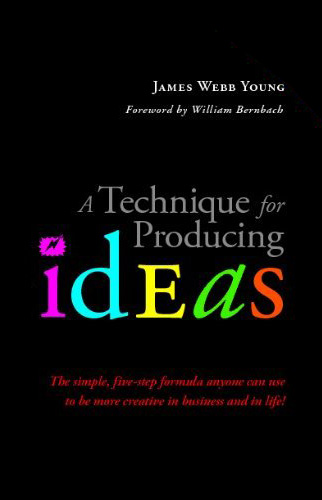 Literature is the original “inter-net,” woven of a web of allusions, references, and citations that link different works together into an endless rabbit hole of discovery. Case in point: Last week’s wonderful field guide to creativity,Dancing About Architecture, mentioned in passing an intriguing old book originally published byJames Webb Young in 1939 — A Technique for Producing Ideas (public library), which I promptly hunted down and which will be the best $5 you spend this year, or the most justified trip to your public library.
Young — an ad man by trade but, as we’ll see, a voraciously curious and cross-disciplinary thinker at heart — lays out with striking lucidity and clarity the five essential steps for a productive creative process, touching on a number of elements corroborated by modern science and thinking on creativity: its reliance on process over mystical talent, itscombinatorial nature, its demand for a pondering period, its dependence on the brain’s unconscious processes, and more.
Right from the introduction, original Mad Man and DDB founder Bill Bernbach captures the essence of Young’s ideas, with which Steve Jobs would have no doubt agreed when he proclaimed that “creativity is just connecting things”:
Mr. Young is in the tradition of some of our greatest thinkers when he describes the workings of the creative process. It is a tribute to him that such scientific giants as Bertrand Russell and Albert Einstein have written similarly on this subject. They agree that knowledge is basic to good creative thinking but that it is not enough, that this knowledge must be digested and eventually emerge in the form of fresh, new combinations and relationships. Einstein refers to this as intuition, which he considers the only path to new insights.
To be sure, however, Young marries the intuitive with the practical in his formulation:
[T]he production of ideas is just as definite a process as the production of Fords; that the production of ideas, too, runs on an assembly line; that in this production the mind follows anoperative technique which can be learned and controlled; and that its effective use is just as much a matter of practice in the technique as is the effective use of any tool.
In a chapter on training the mind, Young offers:
In learning any art the important things to learn are, first, Principles, and second, Method. This is true of the art of producing ideas.Particular bits of knowledge are nothing, because they are made up [of] so called rapidly aging facts. Principles and method are everything.[…]So with the art of producing ideas. What is most valuable to know is not where to look for a particular idea, but how to train the mind in the method by which all ideas are produced and how to grasp the principles which are at the source of all ideas.
But the most compelling part of Young’s treatise, in a true embodiment of combinatorial creativity, builds upon the work of legendary Italian sociologist Vilfredo Pareto (of Pareto principle fame) and his The Mind and Society. Young proposes two key principles for creating — that an idea is a new combination and that the ability to generate new combinations depends on the ability to see relationships between different elements.
The first [principle is] that an idea is nothing more nor less than a new combination of old elements.[…]The second important principle involved is that the capacity to bring old elements into new combinations depends largely on the ability to see relationships. Here, I suspect, is where minds differ to the greatest degree when it comes to the production of ideas. To some minds each fact is a separate bit of knowledge. To others it is a link in a chain of knowledge. It has relationships and similarities. It is not so much a fact as it is an illustration of a general law applying to a whole series of facts.[…]Consequently the habit of mind which leads to a search for relationships between facts becomes of the highest importance in the production of ideas.
STEP 1: GATHERING RAW MATERIAL
Young talks about the importance of building a rich pool of “raw material” — mental resources from which to build new combinations — in a way that resonates deeply with the Brain Pickings founding philosophy, and also articulates the increasing importance of quality information filters in our modern information diet. This notion of gathering raw material is the first step in his outline of the creative process:
Gathering raw material in a real way is not as simple as it sounds. It is such a terrible chore that we are constantly trying to dodge it. The time that ought to be spent in material gathering is spent in wool gathering. Instead of working systematically at the job of gathering raw material we sit around hoping for inspiration to strike us. When we do that we are trying to get the mind to take the fourth step in the idea-producing process while we dodge the preceding steps.
Even seven decades into the past, Young knew that the future belongs to the curious. His insistence on the importance of curiosity would make Richard Feynman nod in agreement:
Every really good creative person…whom I have ever known has always had two noticeable characteristics. First, there was no subject under the sun in which he could not easily get interested — from, say, Egyptian burial customs to modern art. Every facet of life had fascination for him. Second, he was an extensive browser in all sorts of fields of information. For it is with the advertising man as with the cow: no browsing, no milk.[…]The process is something like that which takes place in the kaleidoscope. The kaleidoscope, as you know, is an instrument which designers sometimes use in searching for new patterns. It has little pieces of colored glass in it, and when these are viewed through a prism they reveal all sorts of geometrical designs. Every turn of its crank shifts these bits of glass into a new relationship and reveals a new pattern. The mathematical possibilities of such new combinations in the kaleidoscope are enormous, and the greater the number of pieces of glass in it the greater become the possibilities for new and striking combinations.
(I once used a similar analogy with LEGO.)
STEP 2: DIGESTING THE MATERIAL
In his second stage of the creative process, digesting the material, Young affirms Paola Antonelli’s brilliant metaphor of the curious octopus:
What you do is to take the different bits of material which you have gathered and feel them all over, as it were, with the tentacles of the mind. You take one fact, turn it this way and that, look at it in different lights, and feel for the meaning of it. You bring two facts together and see how they fit. What you are seeking now is the relationship, a synthesis where everything will come together in a neat combination, like a jig-saw puzzle.
STEP 3: UNCONSCIOUS PROCESSING
In his third stage of the creative process, Young stresses the importance of making absolutely “no effort of a direct nature”:
It is important to realize that this is just as definite and just as necessary a stage in the process as the two preceding ones. What you have to do at this time, apparently, is to turn the problem over to your unconscious mind and let it work while you sleep.[…][W]hen you reach this third stage in the production of an idea, drop the problem completely and turn to whatever stimulates your imagination and emotions. Listen to music, go to the theater or movies, read poetry or a detective story.
STEP 4: THE A-HA MOMENT
Then and only then, Young promises, everything will click in the fourth stage of the seemingly serendipitous a-ha! moment:
Out of nowhere the Idea will appear.It will come to you when you are least expecting it — while shaving, or bathing, or most often when you are half awake in the morning. It may waken you in the middle of the night.
STEP 5: IDEA MEETS REALITY
Young calls the last stage “the cold, gray dawn of the morning after,” when your newborn idea has to face reality:
It requires a deal of patient working over to make most ideas fit the exact conditions, or the practical exigencies, under which they must work. And here is where many good ideas are lost. The idea man, like the inventor, is often not patient enough or practical enough to go through with this adapting part of the process. But it has to be done if you are to put ideas to work in a work-a-day world.Do not make the mistake of holding your idea close to your chest at this stage. Submit it to the criticism of the judicious.When you do, a surprising thing will happen. You will find that a good idea has, as it were, self-expanding qualities. It stimulates those who see it to add to it. Thus possibilities in it which you have overlooked will come to light.
* * *
Years later, upon reissuing A Technique for Producing Ideas, Young recounted the many letters he had gotten from “poets, painters, engineers, scientists, and even one writer of legal briefs” who had found his technique empowering and helpful. But what’s perhaps most interesting is the following note he made to the postscript of a reprint:
From my own further experience in advertising, government, and public affairs I find no essential points which I would modify in the idea-producing process. There is one, however, on which I would put greater emphasis. This is as to the store of general materials in the idea-producer’s reservoir.[…]I am convinced, however, that you gather this vicarious experience best, not when you are boning up on it for an immediate purpose, but when you are pursuing it as an end in itself.
 Brain Pickings has a free weekly newsletter and people say it’s cool. It comes out on Sundays and offers the week’s best articles. Here’s what to expect. Like? Sign up.


Friday, September 7, 2012
Tuesday, September 4, 2012
p1 habits of mind, habits of problem solving crit
TTH crew and their problem solving habits.

Students hunt for habits and patterns in problem solving so that they can expand their options and reduce habitual limitations. Typical patterns in problem solving space lay in the areas of scale, distances, relational shifts (of scale, distance, placement or density), density, placement (within page). It is always amazing to discover how we limit ourselves with rules that are not even given but simply habits of mind.


A few more thumbnails per concept that break out of problem solving habits--then on to narrowing down and refining strongest comps in the set.
Monday, September 3, 2012
WEEKend 1 surface to-do checklist
Read/Respond [VJ-surface Visual Journal]
- ___ write summary of first morning [refine/synthesize notes] and add your thoughts/opinions, agree/disagree and why with what was discussed in studio.
- ___ NOTE at least 5 things worth remembering.
- ___ record quote and expound on why you agree/disagree or a combo in VJ
- ___ READ [P1] dot handout thoroughly.
- ___ READ syllabus
- ___ define vocabulary [listed on p1 handout]
- ___ thirty (30) thumbnails for [p1] dot in VJ
10 – proximity 10 – continuance 10 – similarity

- ___ xerox copy thumbnails and cut them a part from one another


- ___ store individual thumbnails in envelop in VJ
- ___ we will be process critiquing these promptly at 9:30 be sure they are all cut a part from one another
Compass, circle template, cardstock paper, more white paper, lots of sharpies, pencils, black construction paper, scissors, photo matte paper, ream of white paper, ream of what cardstock, VJ
Week 2 T/W checklist
-->
a.
read/research
i. Read up on gestalt
b.
make/complete set of 15 well crafted bw dot comps (5
for proximity, 5 for continuance, 5 for similarity)—5.5 x 5.5”. Due next studio
9:30 am for process critique
c.
materials for Wednesday—cardstock/Bristol or
inkjet matte photo paper, black construction paper, sharpies
Subscribe to:
Posts (Atom)


